Why Your Lagree Shake Stops (And Why That Is Not Always Progress)
Quick Answer: The shake comes from motor units firing asynchronously under slow, sustained tension. It stops for two very different reasons — either you have improved motor unit recruitment and synchronization, which is real progress, or you have started borrowing range, momentum, and other muscle groups, which is not. Time under tension and range of motion tell you which one it is.
Everybody remembers the first class. The shake so severe you could not tell if your leg was going to hold.
Then one day, maybe eight weeks in, it does not happen anymore. And the interpretation is immediate and universal: I must be getting stronger.
Sometimes. Not always. Here is how to tell.

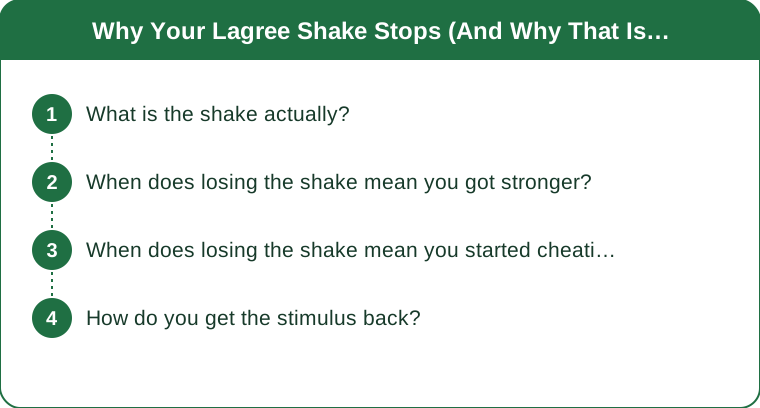
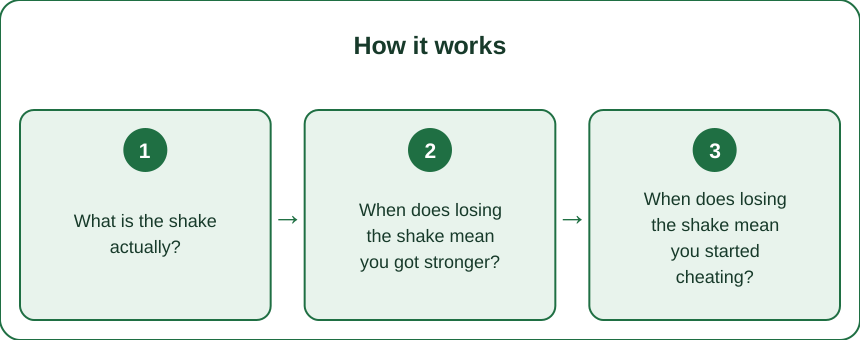
What is the shake actually?
It is a visible expression of how your nervous system manages sustained low-to-moderate load.
Muscles are organized into motor units — a nerve and the fibers it controls. Under sustained tension, your nervous system does not fire all of them at once. It rotates through them, allowing some to recover while others work.
The shake appears when that rotation becomes uneven. As available motor units fatigue, the handoffs get less smooth, and the tremor you see is the mechanical result of units cutting in and out at slightly different moments.
This is why Lagree produces so much of it. Slow tempo plus sustained tension plus a moderate load is precisely the condition that maximizes it — the load is low enough that you cannot recruit everything at once and finish, but high enough that fatigue accumulates continuously.
It is a fatigue signal, not a damage signal, and it is not itself the mechanism of adaptation. The shake is a byproduct of the stimulus, not the stimulus. That distinction matters for what follows.
When does losing the shake mean you got stronger?
When the improvement happened in your nervous system, which is the majority of early progress in this kind of training.
Motor unit synchronization improves with practice. Your nervous system gets better at the handoffs, recruiting and derecruiting more smoothly. That produces a genuinely steadier limb under identical load.
Recruitment threshold improves too. Early on, you recruit inefficiently and fatigue the available units fast. With training you access more of them sooner and distribute the work better.
And stabilizers stop working overtime. A lot of first-month shaking is stabilizing muscles fighting for balance rather than the prime movers fatiguing. As balance and coordination improve, that layer of tremor disappears while the actual working muscles are doing more than before.
The markers that confirm this is what happened: you are holding the same position for longer than you used to, at the same or greater range, at the same or heavier spring load, and you still finish the set at genuine failure. If all four are true, you got stronger. The shake left for a good reason.

When does losing the shake mean you started cheating?
When something else quietly took over the work, and this is far more common than people admit.
Range shortened. The most frequent one. Over weeks, the bottom of the lunge rises by a few centimeters and the top stops just short of lockout — a range reduction that is invisible in the mirror and removes the hardest portion of the movement entirely. Time under tension in the hard range can drop by a third without the set looking any different.
Tempo sped up. Lagree’s stimulus depends on slow. Speeding up introduces momentum, and momentum does the work that tension was doing. Most people speed up when a class gets hard, not when it gets easy.
Recruitment shifted. Gripping the handles harder, letting the lower back take a plank, letting the quad take over a movement meant for the glute. The work still happens; it happens somewhere else.
Bracing replaced control. Locking joints and holding rigid stops the tremor mechanically without reducing effort — it just removes the active control that was producing it.
5 Signs the Shake Left for the Wrong Reason
- You finish sets feeling like you could do more. Genuine progress in this modality still ends at failure; you just reach it later.
- Your times have not changed. If you got stronger, the hold should be longer. Same duration plus no shake usually means less range.
- You stopped adding spring load. Progression stalled but the sensation changed — that combination points at technique drift, not adaptation.
- Instructors correct your range more than they used to. External feedback catches this well before you feel it.
- A different muscle is sore afterwards. Soreness that migrated from glute to quad, or from core to lower back, is a recruitment shift wearing a disguise.
How do you get the stimulus back?
Restore the variables that produced it, in this order.
Range before load. Go back to full range at a lighter spring rather than partial range at a heavier one. Full range at less load is a better stimulus than partial range at more, and it is the correction with the fastest return.
Slow down beyond what feels reasonable. If the count is four seconds, try six. Tempo is the most powerful and most neglected variable in this training, and it costs nothing.
Add pauses at the hardest point. A two-second pause at the bottom of the range removes any remaining momentum and reintroduces the sustained tension that produces the effect.
Change the movement. Adaptation is specific. Eight weeks of the same lunge produces a very efficient lunge. A slightly different foot position or a different variation restores novelty to the pattern.
And a reframe worth having: do not chase the shake. It is a useful diagnostic and a poor goal. Training designed to produce maximum tremor tends to prioritize sensation over progressive overload, and sensation is not the thing that makes you stronger. Track your hold times, your range, and your spring load. Those three numbers tell you whether you are progressing. The shake will do whatever it does.
This is general fitness information, not medical advice.
TL;DR:
- The shake is uneven motor unit rotation under sustained tension — a byproduct of the stimulus, not the stimulus itself.
- Losing it is real progress if hold times, range, and spring load all held or improved and you still reach failure.
- Losing it is technique drift if range shortened, tempo sped up, or the work migrated to another muscle.
- Shortened range is the most common culprit and is nearly invisible in the mirror.
- Restore range before load, slow the tempo beyond comfort, add pauses — and track times, range, and load rather than chasing sensation.
See It in Motion
Seen here: High Waist Bootcut Yoga Pants with Side Pockets — shop it on bubblelime.com
Keep Reading
This article is for general informational and styling purposes only. Fit, sizing, and product availability may vary.