Why Your Carriage Slams on the Return and How to Stop It
Quick Answer: The carriage slams because you are producing force in one direction only. On the way out you push; on the way back you release and let the springs do the work. That skips the eccentric contraction, which is where a large share of the strength and hypertrophy stimulus lives, and it also removes the slow tension that makes Lagree feel like Lagree. The fix is to think of the return as a movement you perform against the springs, not a movement the springs perform on you.
If the carriage is silent, the tension never left.

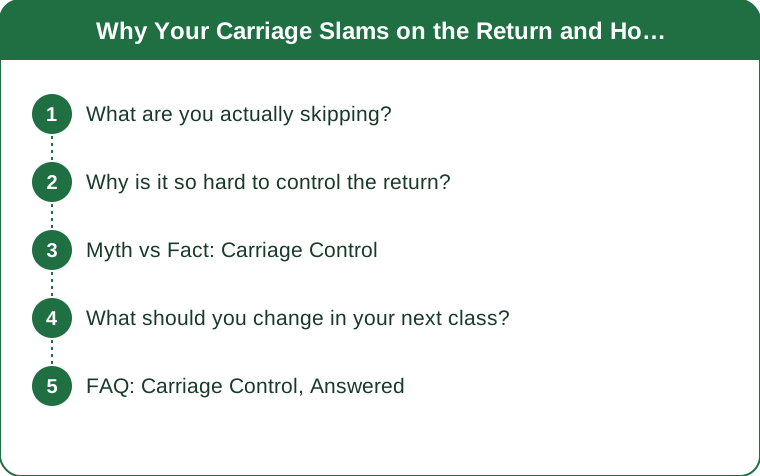
What are you actually skipping?
Every rep has two halves. The concentric phase, where the muscle shortens under load, and the eccentric phase, where it lengthens under load.
On a megaformer, pushing the carriage out is usually concentric. Letting it come back is where the muscle should be lengthening under control, resisting the spring the whole way.
Eccentric contraction is where a large part of the adaptation happens. Muscles can produce more force eccentrically than concentrically, eccentric loading is a potent stimulus for strength and hypertrophy, and it is also where most of the time-under-tension in a slow-tempo method accumulates.
When the carriage slams, you have given all of that away. The spring returns the carriage; you along for the ride. In a 45-minute class doing that on every rep, you have roughly halved the effective work.
There is a second cost that people notice before the first. The characteristic Lagree shake comes from sustained tension at a slow tempo. Slamming interrupts the tension every rep, which is why classes where you are slamming feel easier and produce less of the shake, and why people conclude the class was not hard rather than that they were not doing it.
And a third: joint load. A carriage arriving at the stop with momentum sends that momentum through whichever joint is attached to it. Repeated over a class, that is the least useful way to accumulate load.
Why is it so hard to control the return?
Several reasons, and they are all fixable.
Spring tension is set too heavy. Counterintuitively, heavier springs make the return harder to control, because there is more force pulling the carriage home and you need more strength to resist it. Many people who slam are on a load appropriate for the pushing half and too heavy for the returning half. Dropping a spring often fixes the noise instantly.
Range is too long. The last part of the return, closest to the stop, is where the spring is at its shortest and its pull is strongest. Shortening the range slightly so you turn around before the spring reaches full recoil is a legitimate and widely-taught adjustment.
The tempo is being counted rather than felt. A four-count return that speeds up over the last count is the standard pattern. The last count is where the slam happens and it is the count that matters most.
Fatigue, which is the honest answer for most reps. Control fails before force production does, so the slam appears at rep nine of twelve as the stabilisers give out. This is normal and it is the signal to stop the set or reduce the load, not to push three more sloppy reps.
And breath-holding. People hold their breath through the effortful part and exhale at the turnaround, which coincides with a loss of trunk tension exactly where the control is needed.

Myth vs Fact: Carriage Control
Myth: Heavier springs mean a harder workout. Fact: Heavier springs make the push harder and the return harder to control. If the extra load costs you the eccentric half, it is a net loss. The right load is the heaviest one where you can still control the return silently.
Myth: The slam only matters for noise and etiquette. Fact: The noise is a symptom. The actual cost is losing the eccentric portion of every rep plus the joint impact.
Myth: Slow means the same speed both ways. Fact: In most Lagree teaching the return is deliberately slower than the push, often four counts out and four or more back, precisely because the eccentric is where the value is.
Myth: If you are shaking you are doing it right. Fact: The shake is a sign of sustained tension and fatigue in the stabilisers. It is a good sign and it is not the goal, and chasing it with poor form is how people get hurt.
Myth: Going lighter is a step backwards. Fact: A lighter spring with full eccentric control produces more time under tension than a heavier spring with a slam. It is a progression, not a regression.
Myth: You should never let the carriage touch. Fact: In many exercises a soft touch at the stop is fine. The distinction is arriving under control versus arriving under momentum.
What should you change in your next class?
Drop one spring and see what happens. If the noise disappears and the shake arrives sooner, the load was the problem. This is the single highest-value change and most people resist it.
Count the return slower than the push. If the instructor calls four out and four back, aim for four out and five back. Deliberately over-slowing the eccentric compensates for the natural tendency to accelerate into the stop.
Own the last two inches specifically. Pick one exercise per class and make the final part of the return the slowest part. That is where the spring pull peaks and where technique breaks.
Shorten the range before you reduce the tempo. If you cannot control the full range, use three quarters of it with full control rather than the whole thing with a slam.
Exhale on the return, not at the turnaround. Breathing out through the eccentric keeps the trunk engaged through the part where control is needed.
Stop the set when control goes. The last two sloppy reps contribute little and carry most of the risk. Ending a set at nine controlled reps beats twelve with three slams.
Listen deliberately for one whole class. Most people have no idea how often they slam because they are focused on the effort. Making noise your feedback signal for one class is remarkably effective.
And if a joint hurts rather than a muscle burning, that is different. Wrist, shoulder or knee pain during carriage work warrants a conversation with the instructor and, if it persists, a professional. This is general information, not medical advice.
FAQ: Carriage Control, Answered
Is a light touch at the stop acceptable?
Usually yes, if you arrive under control. Arriving with momentum is the problem, not contact.
Should the return always be slower than the push?
In most Lagree work, yes. Some explosive or pulsing variations are exceptions, and your instructor will call those.
Why do I only slam on one side?
Almost always a strength or control asymmetry. Set the load for the weaker side and let the stronger side do easier reps.
Does lighter spring load mean less results?
No, if it buys you the eccentric half of every rep. Time under tension is the currency in this method.
Where does the shake come from?
Sustained low-level tension fatiguing the stabilising muscles. It is a byproduct of doing it properly, not a target.
How long until control improves?
Most people notice a difference within three or four classes of consciously slowing the return, because it is largely a motor control adjustment rather than a strength gain.
TL;DR:
- A slamming carriage means you are skipping the eccentric half of every rep.
- Eccentric loading is where much of the strength stimulus and nearly all of the time under tension lives.
- Heavier springs make the return harder to control, so dropping a spring often fixes it.
- Make the return slower than the push and own the last two inches.
- Exhale through the return rather than at the turnaround.
- Stop the set when control fails; sloppy reps carry the risk without the benefit.
A silent carriage is not politeness. It is the whole exercise.
See It in Motion
Seen here: Racerback Tank Top - White — shop similar styles on bubblelime.com
Keep Reading
This article is for general informational and styling purposes only. Fit, sizing, and product availability may vary.