Why Your Lagree Progress Stalls Right When Your Form Improves
Quick Answer: As your form improves you remove the momentum, the swing and the assistance from secondary muscles that were previously doing part of the work. The target muscle now carries the full load, so your numbers drop. A 60-second hold with borrowed momentum is genuinely easier than a 35-second hold with none. This dip typically lasts two to four weeks, and the giveaway that it is progress rather than decline is that the shake arrives earlier and in the right place.
You finally stopped rushing. You are moving at the tempo the instructor keeps calling for. And you are lasting half as long as you did a month ago.
That is not a plateau. It is what a genuine increase in difficulty looks like from the inside.

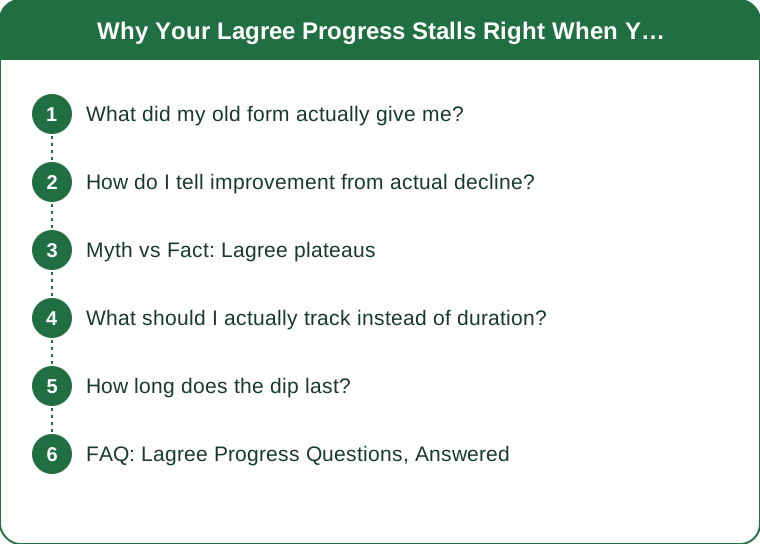
What did my old form actually give me?
Momentum, mostly, and a few helpers.
Momentum removes the hardest part of the range. A carriage moving with speed carries itself through the transition where tension is highest. Slowing down puts that transition back into your muscles, and it is the most expensive part of the movement.
Secondary muscles were sharing the load. Gripping with the hands, bracing through the shoulders, letting the hip flexors take over a core exercise. Each one shaves load off the target and adds it somewhere durable.
Range was probably shorter than you thought. Video is brutal here. Most people lose an inch or two at each end without noticing, and those inches sit exactly where the load is highest.
Remove all three and the same exercise at the same spring setting is a materially harder exercise. The number went down because the exercise went up.
How do I tell improvement from actual decline?
Four signals separate them cleanly.
Where the shake starts. Better form moves the shake into the target muscle and away from the gripping hands or the neck. Same shake in a better place is progress.
When the shake starts. Earlier onset at the same spring setting means you reached real tension sooner. That is a load increase.
Soreness location the next day. If you are now sore in the muscle the exercise names rather than in your forearms and traps, you fixed something.
Consistency across the class. Decline is global and applies to everything including the exercises you have not changed. Form-driven dips are exercise-specific and show up first in the movements you were cheating hardest.
If all four point the right way, hold your nerve. If none of them do, look at sleep, fuelling and how many classes you are doing.
Myth vs Fact: Lagree plateaus
Myth: Higher spring load means a harder workout. Fact: On many Lagree movements, lighter springs are harder because they demand more stabilisation and give you less to push against. Adding springs can be a way of hiding from an exercise.
Myth: If you are not lasting longer each week, you are not progressing. Fact: Time under tension only compares like with like. Two holds with different tempo and range are not the same test.
Myth: More classes fixes a plateau. Fact: Lagree is high-fatigue, low-recovery-friendly work. Going from three classes to five is one of the most reliable ways to stall, not to progress.
Myth: The shake is a measure of effort. Fact: The shake is a measure of a muscle working near its endurance limit in a stabilising role. Useful, but it tells you about that muscle, not about whether the exercise was well executed.

What should I actually track instead of duration?
Duration is a poor variable while your technique is changing. Better options:
-
Tempo compliance. Did you hold the four-count out and four-count back for the whole set, or the first six reps? Track the number of reps at full tempo, not total reps.
-
Range markers. Pick a visual reference on the carriage. Track how many reps reach it before your range shortens.
-
Break count. How many times you came out of the position during a set. Going from four breaks to two at the same duration is a clear gain.
-
Spring setting at equal quality. The honest progression metric. When you can hold your standard for a full set, then change the springs.
-
Shake onset time. Note roughly when it starts. Earlier at the same setting means more tension reached sooner.
Write two of these down after class for four weeks. The picture that emerges is almost always more encouraging than the duration number was.
How long does the dip last?
For most people, two to four weeks before the numbers start climbing again from the new baseline. Longer if you are correcting several habits at once.
There is a reason to be a little patient beyond stubbornness: you are not just building strength, you are rebuilding a motor pattern, and pattern changes take repetition before they stop costing extra energy. Early on, good form is metabolically more expensive because you are actively suppressing an old habit.
Once the new pattern becomes the default, that overhead disappears and the endurance returns quickly, usually faster than it took to build the first time.
One correction at a time is the fastest route through. Fix tempo this month, range next month. Trying to fix everything simultaneously stretches the dip out and makes it harder to tell what worked.
FAQ: Lagree Progress Questions, Answered
Should I drop a spring while I fix my form?
Often yes, and it is not a step backwards. Lighter springs on stabilisation-heavy moves are frequently harder anyway. Fix the pattern where you can hold it, then rebuild load.
Is it normal to feel worse in class while getting better?
Very. Better form means less rest inside the movement, and the subjective experience of a set with no coasting is genuinely harder even when the objective numbers are lower.
How many classes per week is right during this phase?
Three is plenty and often better than four or five. You are asking for motor learning, and motor learning needs recovery to consolidate.
This is general information, not medical advice.
TL;DR:
- Better form removes momentum, helper muscles and hidden range shortcuts, so the same exercise gets genuinely harder.
- The tell that it is progress: the shake arrives earlier and in the right muscle, and soreness moves to the target.
- Track tempo compliance, range and break count instead of duration while technique is changing.
- Expect two to four weeks, and fix one thing at a time.
The month your numbers drop is usually the month you stopped cheating. That is an uncomfortable form of progress, but it is the only kind that keeps paying off after the novelty wears off.
See It in Motion
Seen here: Racerback Tank Top - White — shop similar styles on bubblelime.com
Keep Reading
This article is for general informational and styling purposes only. Fit, sizing, and product availability may vary.