Why Your Lagree Form Falls Apart in the Last Ten Seconds
Quick Answer: Lagree form typically breaks in the final ten seconds because the slow tempo produces sustained time under tension, and once the primary muscle reaches its endurance limit the body recruits substitute muscles automatically. That substitution is what you feel as your form changing - hips dropping, shoulders creeping up, tempo speeding up. Slowing down rather than pushing through, and reducing spring load before the breakdown point rather than after, is what actually builds the capacity.
You are 50 seconds into a set. Everything is controlled. Then the counter hits 60 and your hips drop, your tempo doubles, and the instructor says your name in that particular tone.

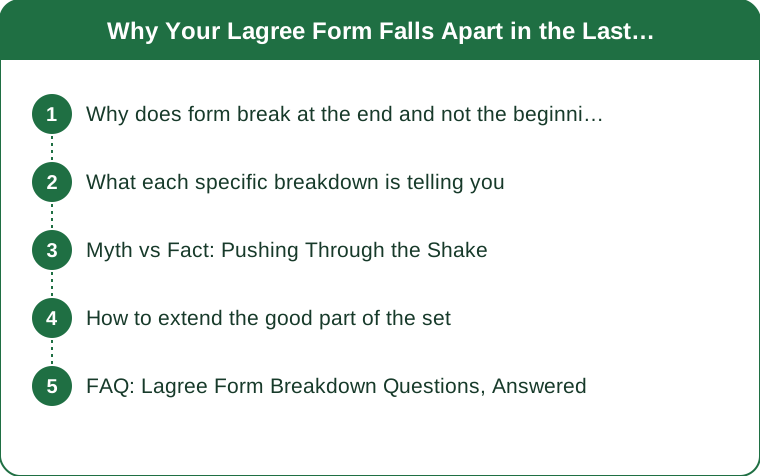
Why does form break at the end and not the beginning?
Because the exercise is specifically designed to find that point.
Lagree uses slow tempo to maximise time under tension. A four-count out and four-count back keeps the muscle loaded continuously, with no rest at either end of the range. That is the entire premise of the method.
Continuous tension restricts blood flow to the working muscle. Sustained contraction compresses the vessels running through it, which limits oxygen delivery and accelerates metabolite accumulation. The burn is not incidental; it is the intended stimulus.
The primary muscle reaches its limit before the movement becomes impossible. This is the key point. Your glutes reach failure while your body still has other options, so it automatically deploys them.
Substitution is involuntary and largely unnoticed. The nervous system recruits secondary muscles to complete the task without asking your permission. You do not decide to use your lower back; it simply arrives.
Which is why form changes rather than movement stopping. If substitution were not available, the set would just end. Instead the shape of the exercise degrades while the movement continues, and that is the moment the training value drops.
And speeding up is the most common substitution of all. Faster tempo uses momentum, which reduces muscular demand at the ends of the range. It is the body’s most efficient way of continuing when the target muscle has had enough.
What each specific breakdown is telling you
The way your form fails identifies which muscle quit.
Hips dropping in a plank or bear position: the trunk gave out. The deep abdominal muscles stopped holding the pelvis, and the lower back is now taking the load. This is the most common breakdown and the one most worth stopping for.
Shoulders creeping toward the ears: the scapular stabilisers gave out. The lower trapezius and serratus stopped holding the shoulder blade down and the upper trapezius took over. Sustained work in that position is how people leave Lagree with neck tightness.
Tempo speeding up: everything gave out slightly. The general substitution. Momentum is doing part of the job that the muscle was doing.
Range shortening: the muscle is failing at its longest position. Most exercises are hardest at end range, so the body quietly reduces the range to stay in the strong zone. Watch the carriage travel rather than the effort - it shrinks before you notice.
Weight shifting to one side: the weaker side gave out first. Extremely common in lunges and single-leg work, and almost invisible without a mirror or an instructor.
Breath holding: the trunk is bracing to compensate. Holding the breath stiffens the torso and buys a few extra seconds. It is a reliable signal that you are past the useful part of the set.

Myth vs Fact: Pushing Through the Shake
Myth: The last ten seconds are the most valuable part of the set. Fact: The last ten seconds with good form are the most valuable. The last ten seconds with substitution are training the substitute muscles instead, which is why some people develop neck and lower-back tightness rather than the intended strength.
Myth: If you can still move, you should keep going. Fact: Being able to move and being able to move well are different things. Once the movement pattern changes, the exercise has effectively become a different exercise - usually a worse one.
Myth: Shaking means you should stop. Fact: Shaking is normal and expected in Lagree - it reflects motor units firing asynchronously under sustained load. Shaking with maintained form is the target. Shaking with collapsing form is the stop signal.
Myth: More spring tension makes everything harder and therefore better. Fact: Spring load changes which part of the movement is hardest, not simply how hard it is overall. Heavier springs frequently make an exercise easier through the range and harder at one point, and for many exercises fewer springs is the genuinely harder option.
Myth: Failing early means you are unfit. Fact: Time to failure in this format depends heavily on muscular endurance and on how efficiently you hold position, both of which are trainable skills rather than fitness verdicts. People who look calm at 60 seconds are frequently spending less energy on stabilising, not working less hard.
Myth: You should never modify in class. Fact: Reducing springs or taking the modified version at the point where form starts to change is the technically correct action and every good instructor prefers it. Grinding out a degraded final ten seconds builds the wrong pattern and is the main reason plateaus happen.
How to extend the good part of the set
The goal is not to survive 60 seconds. It is to make 60 seconds of quality possible.
Set up more carefully than feels necessary. A significant proportion of early breakdowns are set-up problems that were always going to fail - hands slightly too far forward, hips slightly off centre. Position errors compound under fatigue.
Breathe on a fixed pattern from the first repetition. Exhale on the effort, inhale on the return, and keep it going. Once breathing stops, the countdown to breakdown accelerates sharply.
Reduce spring load before the breakdown, not after. If you consistently fail at 45 seconds, take a spring off and complete 60 seconds well. That builds the capacity to do 60 seconds at the higher load in a few weeks. Repeatedly grinding out degraded reps does not.
Cue the specific area that fails for you. If it is always the hips, actively think about the hip position from the start rather than reacting when it drops. Anticipatory cueing works considerably better than corrective cueing.
Slow down rather than speeding up when it gets hard. Counterintuitive and correct. Slowing preserves the tension and prevents momentum substitution, and it is the single most useful in-the-moment adjustment available.
Take the modification with intent. Dropping to knees or reducing range deliberately is an entirely different thing from having range collapse involuntarily. One is a choice; the other is a failure.
And expect progress in seconds, not spring numbers. Going from 40 seconds of quality to 55 seconds of quality at the same load is real progress that no one can see from the outside.
This is general information, not medical advice. Sharp pain, joint pain, or symptoms that persist after class should be assessed by a professional.
FAQ: Lagree Form Breakdown Questions, Answered
Why does my form fall apart at the end of every set?
Because the slow tempo drives the primary muscle to its endurance limit while other muscles are still available, and the nervous system recruits them automatically. The form change is that substitution becoming visible.
Should I push through when my form starts to go?
Generally no. Once the pattern changes, you are training substitute muscles rather than the intended ones. Reducing springs or modifying at that point produces better results than grinding out degraded seconds.
Is shaking during Lagree a bad sign?
No, shaking under sustained load is expected and reflects motor units firing asynchronously. Shaking while holding good form is the target; shaking while the position collapses is the signal to modify.
Does more spring tension always make an exercise harder?
No. Springs change where in the range the difficulty sits, and for many exercises fewer springs is genuinely harder. Instructors setting a low spring count are not going easy on you.
How do I improve my time under tension?
Reduce the load so you can complete the full duration with good form, and build from there. Progress shows up as more quality seconds at the same spring setting long before it shows up as more springs.
TL;DR:
- Form breaks at the end because the primary muscle hits its limit while substitutes are still available.
- How it breaks tells you what failed - dropped hips mean the trunk, raised shoulders mean the scapular stabilisers.
- Speeding up is the most common substitution, so slow down rather than pushing through.
- Reduce spring load before the breakdown point, not after, and treat modification as the correct technical choice.
- Progress is measured in quality seconds at the same load, not in spring numbers.
Sixty degraded seconds trains your lower back. Forty-five good ones train what the exercise was actually designed for.
See It in Motion
Seen here: High Waist Embossed Yoga Leggings with Side Pockets — shop it on bubblelime.com
Keep Reading
This article is for general informational and styling purposes only. Fit, sizing, and product availability may vary.