Why Your First Lagree Class Back After a Break Feels Brutal
Quick Answer: Lagree feels disproportionately hard after a break because slow eccentric time-under-tension relies on neuromuscular control and local muscular endurance, both of which decline within 10 to 14 days — much faster than maximal strength. Your muscles did not shrink. Your ability to recruit them slowly and steadily did, and that comes back in two to three classes.
You took twelve days off. Nothing dramatic — a work trip, a cold, life.
And then you got back on the machine, set the springs where you always set them, and started shaking at forty seconds on a move you owned three weeks ago.
The good news is that what you lost is the fastest thing to get back.

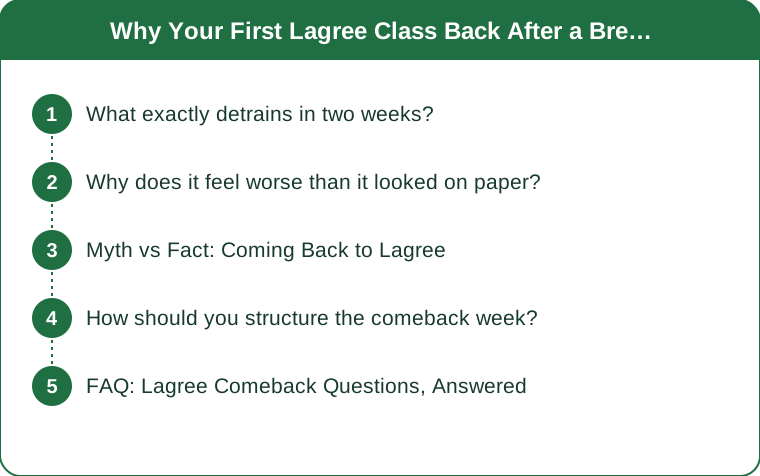
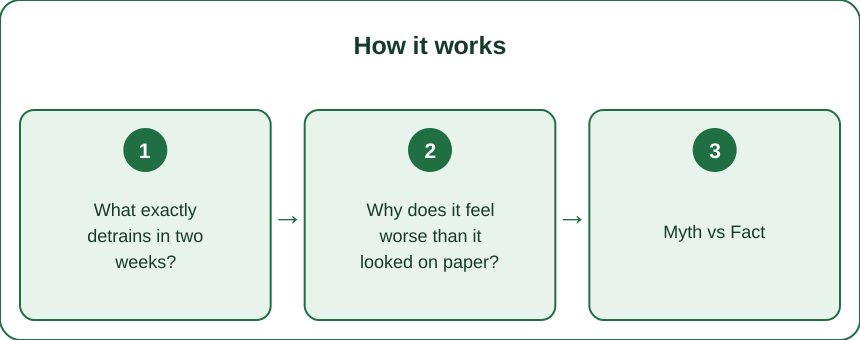
What exactly detrains in two weeks?
Not what you would guess. Muscle cross-sectional area barely moves in two weeks of inactivity. What drops quickly is the nervous system’s ability to hold a submaximal contraction steadily, plus local muscular endurance in the specific slow-tempo pattern Lagree demands.
Lagree is unusual because it lives almost entirely in the 60 to 90 second time-under-tension range with slow eccentrics. That is a niche quality — it is not maximal strength and it is not cardiovascular fitness. It is sustained, controlled, low-velocity output under constant tension.
Niche qualities detrain fast and retrain fast. That is the whole story. Two weeks costs you a meaningful chunk of it; two or three classes bring most of it back.
The shake, by the way, is not failure. It is your motor units cycling on and off as they trade the load between them — a normal response to sustained submaximal effort, and one that gets less dramatic as coordination returns.
Why does it feel worse than it looked on paper?
Because Lagree gives you almost nothing to hide behind.
In most training, momentum, rest between reps, and range shortcuts quietly absorb a bad day. Lagree removes all three. Constant tension, slow tempo, no lockout, no bottom position rest. Whatever you lost is exposed within thirty seconds.
There is also a heat and season factor people underestimate in late summer. Studios run warm, you arrive slightly dehydrated from a hot week, and perceived exertion climbs before you have done anything. If you took your break during a heat wave, you may be layering mild dehydration on top of genuine detraining.
And the psychological piece is real: you remember your best class, not your average one. The bar in your head is your peak, which is not where you were the week before you stopped either.

Myth vs Fact: Coming Back to Lagree
Myth: You should push right back to your old spring load to get back faster.
Fact: Dropping one spring for two classes lets you hold correct tempo, and tempo is the actual stimulus. Heavier springs with broken form retrain nothing but compensations.
Myth: Losing progress in two weeks means the gains were not real.
Fact: They were real. Endurance and neural coordination fluctuate; the structural adaptations underneath are far more durable. That is why a returning client outpaces a true beginner dramatically.
Myth: More classes per week is the fastest way back.
Fact: Three classes in the first week of a comeback usually produces enough soreness to compromise the next two. Two classes with 48 hours between them gets you further.
Myth: The shake means you are doing it right.
Fact: Shaking indicates sustained recruitment, which is fine, but shaking so hard that your tempo collapses means the load is wrong for today.
How should you structure the comeback week?
A simple three-week ramp that avoids the classic overshoot:
- Week 1: two classes, one spring lighter than your normal setting on every move. Priority is tempo — count your eccentrics out loud in your head, four counts down. Expect to feel it in the obliques and hip flexors.
- Week 2: two to three classes, return to your normal spring on lower-body work, keep the lighter setting on anything overhead or plank-based. Shoulders and deep core take longer than legs.
- Week 3: back to your regular schedule and loads. Most people are fully back here, sometimes better than before because the break resolved accumulated fatigue.
Between classes: walk, hydrate, and do nothing heroic. Delayed soreness after a comeback class peaks at 24 to 48 hours and is normal. Sharp joint pain is not — that is a different conversation.
Also worth doing: tell the instructor you are coming back from a break. Good ones will adjust cues for you and it costs nothing but a sentence.
FAQ: Lagree Comeback Questions, Answered
How long can I take off before I lose real strength?
Genuine strength loss becomes measurable somewhere past three to four weeks for most people. Under two weeks, what you feel is almost entirely neural and endurance-related.
Should I do anything during a planned break to hold on to it?
Two short sessions a week of slow-tempo bodyweight work — planks, slow lunges, glute bridges with a four-count lower — preserves most of the relevant quality. Total time under ten minutes.
Why are my obliques so sore specifically?
The plank and lateral work in Lagree loads the obliques isometrically for long durations, which is a pattern most other activities do not replicate. They detrain quickly because nothing else in daily life trains them.
TL;DR:
- Slow-tempo endurance and neuromuscular control fade in 10 to 14 days; muscle mass does not
- The shake is normal motor unit cycling, not failure — but a collapsed tempo means the spring is wrong
- Come back with one spring lighter for two classes, prioritizing eccentric tempo over load
- Two classes with 48 hours between beats three crammed classes in a comeback week
Set your springs one notch lighter next class and count your eccentrics. Most people are back to their old settings by the third class, wondering what the fuss was about.
See It in Motion
Seen here: UPF 50+ Racerback Yoga Tank Top — shop it on bubblelime.com
Keep Reading
This article is for general informational and styling purposes only. Fit, sizing, and product availability may vary.