Why Your Feet Cramp on the Megaformer - and How to Stop It Mid-Class
Quick Answer: Foot cramps on the Megaformer are almost always a gripping problem, not a mineral problem. When your bigger stabilisers - glutes, deep core, and outer hip - are not holding you, your foot tries to create stability by clawing the carriage. The small muscles of the arch are not built for sustained isometric work under load, and after 90 seconds of a slow lunge they seize.
The fast fix mid-class is to press the big toe down and lift the toes off, which breaks the clawing pattern. The real fix is where your weight sits and which muscles are doing the stabilising.
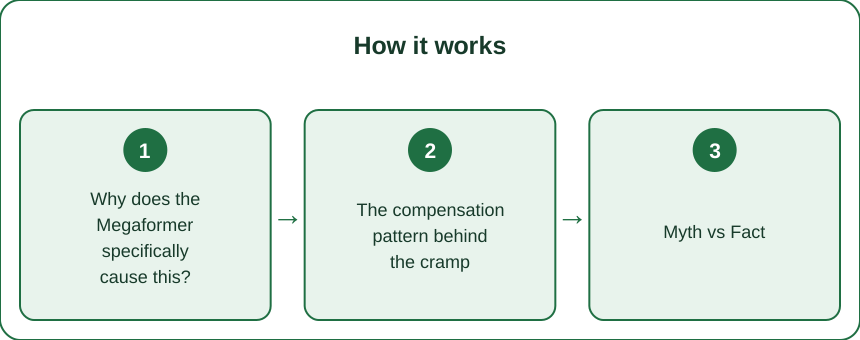
Why does the Megaformer specifically cause this?
Several features of the method converge on the foot in a way that most other training does not.
Time under tension is unusually long. A four-count down and four-count up under spring load means the foot is holding a position for minutes at a time, not seconds. Even well-conditioned intrinsic foot muscles fatigue under that.
The surface is moving. A carriage under tension is asking you to stabilise against something that wants to slide, and the foot is the interface. Instinctively, the foot grips - and unlike your quad, the foot has no strategy other than gripping.
Positions load the foot at unusual angles. Lunges with the back foot on the platform, kneeling work with the toes tucked, single-leg positions - many of these hold the foot in dorsiflexion or with the toes flexed under load for extended periods.
And you are usually barefoot or in grip socks. No midsole, no arch support, so the arch is working the way it was designed to and often is not conditioned to. For anyone who spends the rest of their week in supportive shoes, this alone is a significant new demand.
Then there is the shake. As larger muscles fatigue and the shake begins, compensation patterns cascade downward, and the foot is the last stop. The cramp typically arrives a few seconds after the shake gets serious, which is a useful diagnostic clue.
The compensation pattern behind the cramp
The foot is where you feel it, and it is rarely where the problem starts.
Weight too far forward. In lunges and standing work, weight shifted into the ball of the foot puts the arch under constant tension. Shifting the weight back toward the mid-foot, so the heel is genuinely loaded, takes the arch out of the equation almost immediately.
A quiet glute. If the glute medius is not stabilising the pelvis, the foot compensates by gripping to control the leg’s line. This is why people who cramp in lunges often also feel the knee drifting inward - same root cause.
Toes curling. Look down mid-exercise and you will often find the toes actively curled into the carriage. It feels like stability and it is a cramp in progress. A flat foot with active toes is stable; a clawed foot is fatiguing.
Over-gripping a slippery surface. Worn grip socks make the foot work considerably harder because it is fighting slippage as well as load. This is an unglamorous but genuinely common cause, and grip socks wear out faster than people replace them.
Ankle stiffness. Limited ankle dorsiflexion forces the foot into positions it cannot hold comfortably, particularly in deep lunge work. Calf tightness shows up as a foot problem far more often than as a calf problem.
Myth vs Fact: Foot Cramps in Class
Myth: Cramping means you are dehydrated or low on electrolytes. Fact: The evidence for the electrolyte theory of exercise cramps is far weaker than the popular version suggests, and the current leading explanation is neuromuscular - fatigue-driven overactivity in the muscle’s control system. Hydration is worth getting right anyway; it is unlikely to be why your arch locks at minute four.
Myth: You just need stronger feet. Fact: Foot strength helps and is worth building, but if the cause is a quiet glute or forward weight, stronger feet just means the cramp arrives later. Fix the position first.
Myth: Stretch the foot before class to prevent it. Fact: Static stretching a muscle before it does sustained isometric work does not prevent cramping, and may briefly reduce its capacity. Warm the foot with movement rather than stretching it.
Myth: Bananas. Fact: A banana is a fine snack. Acute potassium deficiency is not what is happening in a Lagree class, and eating one 20 minutes before will not change the neuromuscular fatigue picture.
Myth: It means something is wrong with your feet. Fact: For most people it means the intrinsic foot muscles are being asked to do something new. Frequent, painful cramping outside of class is a different matter and worth a professional opinion.
What to do mid-class, and what to fix long term
Right now, while it is happening:
- Lift the toes off the carriage and press the big toe down. This directly interrupts the clawing pattern and often releases the cramp within a few seconds
- Shift weight to the heel. Take the arch out of the load path
- Stand out for 20 seconds and put the foot flat on the floor. Standing flat is the fastest full reset and costs you almost nothing in a 45-minute class
- Do not stretch it hard while it is cramping. Gentle lengthening is fine; forcing it can leave the muscle sore for days
Between classes, in priority order:
- Fix your weight distribution. In every standing and lunging position, check that you can lift your toes without losing balance. If you cannot, your weight is too far forward - this is the single highest-value change
- Wake the glutes up before class. Two minutes of banded side steps and glute bridges means the pelvis is stabilised by the muscle designed for it
- Build the foot separately. Toe spreads, short-foot exercises, and heel raises - three minutes daily, and expect four to six weeks for a noticeable difference
- Improve ankle dorsiflexion. Knee-to-wall stretches, daily. Ankle range shows up in foot comfort more than almost anything else
- Replace your grip socks. If the grip dots are shiny and flat, they are no longer working, and your foot knows it before you do
Timeline: the mid-class fixes work immediately, the position fixes work within a class or two, and the strength work takes a month or more. If cramps are severe, frequent, happen at rest, or come with numbness or colour changes in the foot, get it assessed rather than trained through. This is general information, not medical advice.
FAQ: Megaformer Foot Cramp Questions, Answered
Should I wear more supportive socks or shoes?
Grip socks with functioning grip are the right choice - the goal is not to support the arch out of the work but to stop it fighting slippage. Adding arch support means the foot never adapts, and the cramping returns the moment you take it away.
Why does it only happen on one side?
Usually an asymmetry further up - a weaker glute or less ankle range on that side means more compensation lands on that foot. Worth checking your knee-to-wall distance on both sides, since the difference is often obvious.
Does it get better with time in the method?
For most people, yes, and fairly quickly - the intrinsic foot muscles condition within weeks. If you are months in and still cramping every class, that points to position rather than conditioning.
Is it worse in the morning classes?
Often, because ankle and foot tissue is stiffer early and you have done less walking to warm it up. Five minutes of walking or heel raises before an early class closes most of that gap.
TL;DR:
- Foot cramps on the Megaformer are a gripping problem caused by instability further up the chain
- Weight too far forward and a quiet glute are the two most common root causes
- Mid-class: lift the toes, press the big toe down, shift to the heel, or stand flat for 20 seconds
- Electrolytes are rarely the answer - the current evidence points to neuromuscular fatigue
- Wake the glutes before class, build foot strength daily, and replace worn grip socks
Next class, check whether you can lift your toes in your lunge. If you cannot, your weight is in the wrong place and the cramp is on its way.
See It in Motion
Seen here: High Waist Yoga Leggings with Side Pockets — shop it on bubblelime.com
Keep Reading
This article is for general informational and styling purposes only. Fit, sizing, and product availability may vary.