Why Your Breathing Fails Before Your Muscles on the Megaformer
Quick Answer: Slow-tempo work under continuous tension restricts breathing because sustained trunk bracing and long time-under-tension both interfere with the breathing mechanism. You end sets short of muscular failure because carbon dioxide builds up and the urge to breathe overrides. Exhale on effort, breathe more often than feels natural, and stop bracing your whole torso.
You are 40 seconds into a set. The muscle is burning but it is not done. And you rack out anyway, because you have stopped being able to breathe properly and your body has made the decision for you.
This happens constantly in Lagree and almost nobody names it correctly. It is worth understanding because it is the difference between finishing sets and almost finishing them.
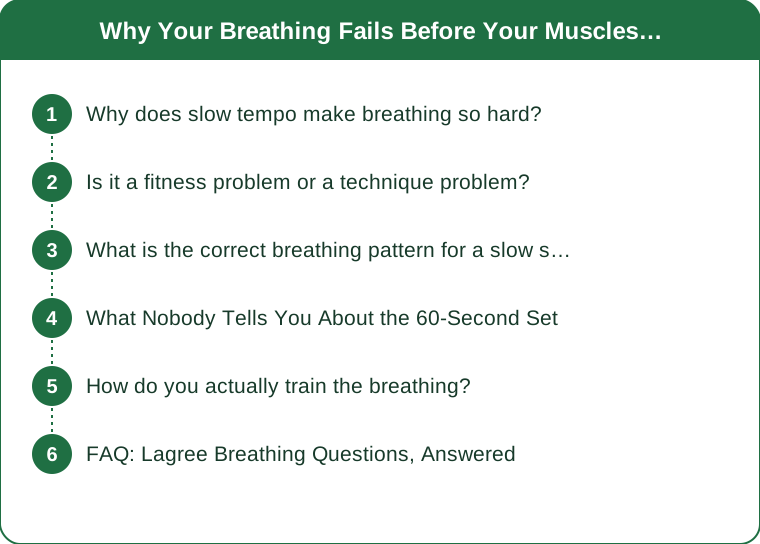
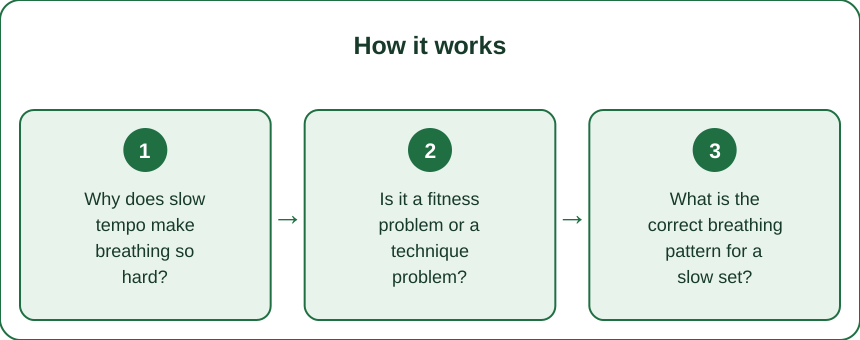
Why does slow tempo make breathing so hard?
Because continuous tension does two things at once, and both interfere.
Sustained muscular contraction restricts blood flow within the working muscle. Under continuous tension with no lockout and no rest, blood flow is partially occluded for the entire set, so metabolites accumulate rather than clearing. Your body responds to that accumulation by driving ventilation up — you need to breathe harder, at exactly the moment your position makes breathing harder.
Trunk bracing restricts the mechanics. To hold a stable plank, lunge or scooter position, you generate intra-abdominal pressure. That pressure works against the diaphragm’s descent, which is what draws air in. The more rigidly you brace, the less your diaphragm can travel, and the shallower every breath becomes.
The result is a set where ventilatory demand is climbing and ventilatory capacity is falling. Something has to give, and the thing that gives is the set.
This is genuinely different from a normal weights set, where each repetition has a moment of reduced tension where you can take a full breath. Lagree deliberately removes those moments — that is the method — which means the breathing has to be managed rather than assumed.
Is it a fitness problem or a technique problem?
Overwhelmingly technique, which is good news.
The tell is that people who are extremely fit in other contexts — runners, cyclists, strong lifters — struggle just as much in their first months of Lagree. Their aerobic capacity is not the limit. Their breathing pattern under sustained brace is.
The most common error is breath-holding without realising it. Under concentration and effort, most people default to a partial Valsalva — holding a braced breath — because it makes the position feel more stable. It does, briefly, and then carbon dioxide climbs and you have to abandon the set to fix it.
The second most common is breathing entirely into the upper chest. Shoulders rise, neck muscles engage, and the volume moved per breath is small. This is expensive and inefficient, and it is why some people finish a Lagree class with a sore neck.
Both are fixable within a few classes with deliberate attention, which is a much better situation than needing to build a new energy system.
What is the correct breathing pattern for a slow set?
More often than feels natural, and out on the hardest part.
Exhale on exertion. As you press away, lower into the burn, or move through the most demanding portion of the range, breathe out. The exhale naturally increases trunk tension through the abdominal wall, which means you get stability without holding your breath for it.
Breathe more frequently than the tempo suggests. A ten-second repetition does not mean one breath per repetition. Two, three or four smaller breaths within a single slow repetition is entirely correct and considerably more sustainable.
Breathe laterally, into the ribs. Rather than pushing the belly out — which reduces trunk stability — expand the lower ribs sideways and back. This gives you volume without losing position, and it is the specific skill that makes long sets survivable.
Do not hold at the top of the burn. The instinctive response to the hardest moment is to freeze and hold everything, breath included. That is the moment you most need air.
Practise it away from the machine: hold a plank, keep the trunk firm, and take twenty deliberate lateral breaths without letting the position sag. If that feels impossible, that is the skill Lagree is asking for and it is trainable in a fortnight.
What Nobody Tells You About the 60-Second Set
The shake is not the same as failure. Shaking is neuromuscular — motor units firing asynchronously under sustained load — and it can appear long before the muscle is actually done. Stopping at the shake means stopping early, most of the time.
Perceived exertion in Lagree is unusually high relative to the physiological load. Continuous tension and restricted breathing both inflate how hard something feels. This is part of why the method works psychologically, and it also means your sensation of being finished is a less reliable signal than in other training.
The last ten seconds is where the adaptation is concentrated. Time under tension near the end of a set recruits the highest-threshold motor units. Ending at 50 seconds instead of 60 does not cost you a sixth of the benefit; it costs disproportionately more.
Your neck is a warning system. If your neck and upper traps are sore after class, you were chest-breathing under strain. It is a reliable diagnostic and it means the breathing pattern needs work rather than the position.
The machine is not harder on some days for mysterious reasons. Sleep, hydration and how recently you ate all affect breathing efficiency more than they affect strength. A class that feels inexplicably brutal usually has an explanation in the preceding 24 hours.
How do you actually train the breathing?
Treat it as a skill with its own practice, because it is one.
In class: pick one exercise per class and make breathing the only thing you focus on. Not form, not depth, not the burn. Just a steady, audible, rhythmic exhale on the hard part. Rotate which exercise gets that attention.
Audible is the trick. Making the exhale slightly loud makes it impossible to hold your breath without noticing. Nobody else is listening.
At home, twice a week, five minutes: a plank or wall sit while performing slow lateral breathing — four seconds in through the nose expanding the ribs, six seconds out through the mouth, maintaining position throughout. Ten breaths, three rounds. Unglamorous and effective.
Before class: two minutes of the same breathing seated, to establish the pattern before the pressure arrives.
How to know it is working: you will finish sets you previously ended early, and the improvement will show up as endurance rather than as strength. Most people notice the change within three to four classes, which is considerably faster than any strength adaptation could plausibly explain.
FAQ: Lagree Breathing Questions, Answered
Should I breathe through my nose or my mouth?
Nose in, mouth out is a good default — the nasal inhale slows the breath slightly and the mouth exhale lets you empty efficiently. Under heavy demand, mouth breathing on both is fine and not worth fighting.
Why do I get dizzy in some positions?
Usually a combination of breath-holding and head position, particularly in inverted or head-below-heart exercises. Restore the breathing pattern first; if dizziness persists across classes, it is worth mentioning to a doctor.
Does this get better with fitness, or only with practice?
Both, but practice moves considerably faster. Fitness improves the underlying capacity over months; breathing technique improves the immediate limit over weeks.
Is it normal to feel more out of breath in Lagree than in running?
Yes, and it surprises runners consistently. The demand is not aerobic in the same way — it is restricted ventilation plus metabolite accumulation, which feels similar and comes from somewhere entirely different.
TL;DR:
- Continuous tension raises ventilatory demand while trunk bracing reduces breathing capacity — sets end on air, not muscle.
- Breath-holding and upper-chest breathing are the two dominant errors, and both are technique rather than fitness.
- Exhale audibly on the hardest part, breathe several times within a single slow repetition, and expand laterally into the ribs.
- The last ten seconds carries disproportionate benefit, so the breathing fix directly buys you the most valuable part of every set.
Pick one exercise in your next class and make the exhale audible for the entire set. It is a small, slightly self-conscious experiment, and most people find they finish that set for the first time.
See It in Motion
Seen here: Crewneck Short Sleeve Workout T-Shirt — shop it on bubblelime.com
Keep Reading
This article is for general informational and styling purposes only. Fit, sizing, and product availability may vary.