Why the Lagree Shake Hits Hard Some Classes and Barely Shows Up Others
Quick Answer: The shake response is driven by muscle fiber fatigue recruitment, which varies based on your recovery state, spring tension that day, and how close a hold is to genuine muscular failure — all of which shift session to session even with identical class content.
You’ve taken the same class format enough times to notice: some days your legs shake uncontrollably in a hold, other days the identical exercise barely registers. That inconsistency isn’t random or a sign of inconsistent effort — it reflects real physiological variables changing under the surface.

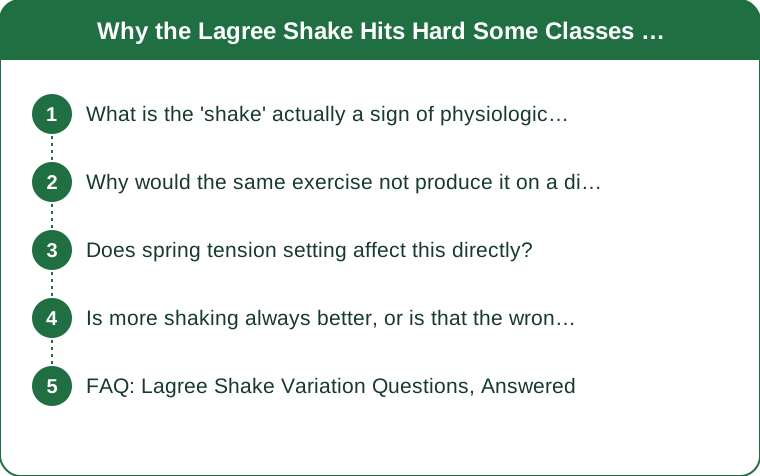
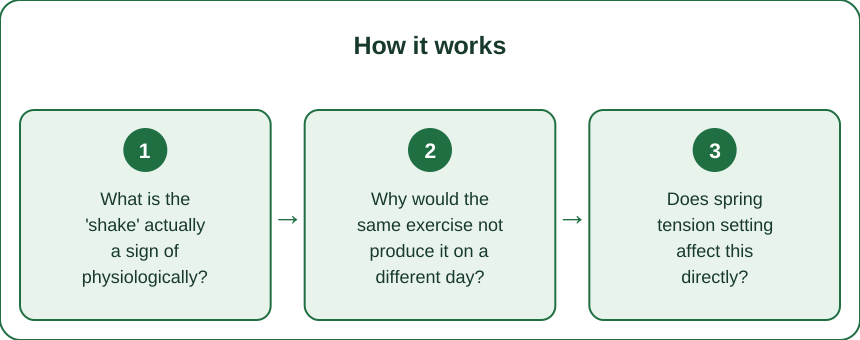
What is the ‘shake’ actually a sign of physiologically?
The shake is generally understood as rapid, alternating recruitment of muscle fibers as fatigued fibers hand off effort to fresher ones in quick succession, near the point of muscular fatigue. It’s a genuine sign you’re working close to a muscle’s current failure point in that hold, not an arbitrary or random response.
Why would the same exercise not produce it on a different day?
Recovery status changes which fibers are already partially fatigued going into class. If you’re well-recovered, more fresh fiber capacity is available, meaning the same hold might not push you as close to failure — reducing or delaying the shake response compared to a day when you’re starting from more accumulated fatigue.

Does spring tension setting affect this directly?
Yes, significantly — a hold at higher spring tension reaches the failure-adjacent recruitment pattern that produces shaking faster than the same hold at lower tension, since higher resistance fatigues fibers more quickly. Many practitioners don’t track their spring settings closely enough to notice this is a variable at all.
Is more shaking always better, or is that the wrong way to think about it?
Not necessarily — the shake is a byproduct of working near failure, not a target in itself. A class without much shaking isn’t automatically less effective if the tension and volume were appropriate; chasing shake as a goal can lead to pushing tension or reps past what’s actually productive for that day’s recovery state.
FAQ: Lagree Shake Variation Questions, Answered
Should I increase spring tension specifically to try to trigger more shaking?
Not as a primary strategy — progressing tension gradually based on overall performance and control is more productive than deliberately chasing the shake sensation itself.
Does hydration or nutrition affect the shake response?
Indirectly — under-fueled or dehydrated muscles fatigue faster, which could increase shaking, but this reflects reduced capacity rather than a ‘better’ workout, so it’s not something to intentionally induce.
Is it a bad sign if I never really get the shake in a full class?
Not inherently — some people’s muscle fiber composition and recovery patterns produce less visible shaking even during genuinely effective, appropriately challenging sessions; visible shake isn’t the only valid marker of a good class.
TL;DR:
- The shake reflects rapid fiber recruitment near a muscle’s current fatigue point, not randomness
- Recovery status going into class changes how quickly a hold reaches that failure-adjacent point
- Spring tension setting directly affects how fast a hold triggers the shake response
- More shaking isn’t automatically a better workout — it’s a byproduct, not a goal to chase
See It in Motion
Seen here: High Waist 8” Yoga Shorts — shop similar styles on bubblelime.com
Keep Reading
This article is for general informational and styling purposes only. Fit, sizing, and product availability may vary.