Why Shaking on the Megaformer Means It Is Working
Quick Answer: Shaking on the megaformer is the mechanical signature of muscle fibres fatiguing and recruiting in waves - slow-twitch fibres exhaust under Lagree’s slow tempo and constant tension, fresh motor units fire unevenly to compensate, and the result is a visible tremble. It means you are exactly in the zone the method targets: deep enough into fatigue that the body is recruiting reserves it normally never touches. Shaking is not a form failure, not weakness, and not dangerous in itself - though shaking plus collapsing form is the cue to back off range, not to push through with sloppy mechanics.
Forty seconds into the escalator lunge, your front thigh starts vibrating like a phone on a table. The instructor sounds delighted. Here is why she is right to be.

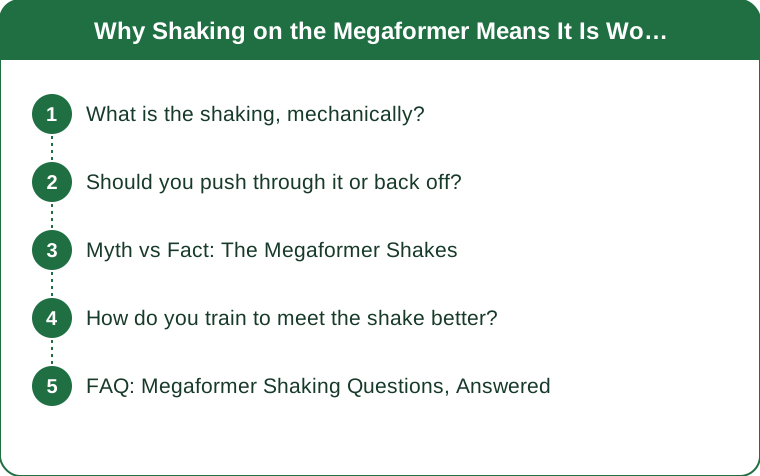
What is the shaking, mechanically?
The tremble has a clean physiological explanation, and none of it is bad news.
Muscles work in teams called motor units. Each unit is one nerve plus the fibres it controls. Smooth movement is thousands of units firing in staggered rotation, covering for each other seamlessly - so seamlessly you never feel the handoffs.
Slow tension exhausts the rotation. Lagree’s signature - four-count tempos, no lockouts, no rest at the top - keeps target muscles under continuous load. The efficient slow-twitch units that handle sustained work fatigue first, and the rotation starts running out of fresh players.
The handoffs become visible. As tired units drop out, the nervous system recruits bigger, fresher units - but the substitutions get ragged. Force output starts arriving in pulses instead of a smooth stream, and pulsing force is, literally, shaking.
The wave recruitment is the point. Those late-recruited units include fibres that ordinary training rarely reaches, because ordinary training rests before the rotation empties. The tremble marks the moment the body is forced to call reserves - which is precisely the stimulus the method is built to create.
Instability multiplies the signal. The moving carriage adds a balance demand on top of the fatigue, so stabiliser muscles are running their own emptying rotation at the same time. Shaking on a megaformer arrives earlier and stronger than on solid ground - by design.
And it is honest. You cannot fake your way to the tremble and you cannot skip to it. It appears exactly when the target muscle has genuinely run down its easy capacity, which makes it one of the most trustworthy signals in fitness.
Should you push through it or back off?
The answer is a decision tree, not a slogan.
Shaking with intact form: stay. Hips level, spine long, the working muscle still doing the work - this is the productive zone. Breathe, slow down if anything speed up, and ride it to the end of the count. These are the seconds the class is priced for.
Shaking with drifting form: shrink, do not stop. When the tremble starts stealing your mechanics - back rounding in a plank-to-pike, front knee wobbling inward in a lunge - reduce the range. Come up an inch, shorten the carriage travel, slow further. A smaller range with honest form keeps the stimulus; a big range with collapsed form moves the load to joints and unintended muscles.
Shaking plus joint pain: out. Muscle burn and tremble are the work; sharp or localised joint pain is not. Step off the carriage, reset, rejoin on the next move. No exceptions clause exists here.
Whole-body shivering versus local tremble. A tired working muscle trembles locally. If you are shivering everywhere, check the basics - skipped meals, dehydration, or gripping every muscle in your body instead of the working one. Often the fix is exhaling and un-clenching your jaw.
The modification hierarchy, in order: slow down, shrink range, add a hand or knee down for stability, then move springs. Speeding up to escape the tremble is the one universally wrong answer - momentum is the method’s only real enemy.
And know that stronger does not mean less shaking. Advanced students shake later and deeper, not never. The tremble migrates as capacity grows; it never retires.

Myth vs Fact: The Megaformer Shakes
Myth: Shaking means you are too weak for the class. Fact: Shaking means the class is working on you. It is fatigue-driven motor unit rotation, and it happens to first-timers and instructors alike - instructors just meet it further into the count.
Myth: If you were strong enough, the tremble would stop. Fact: Strength moves the threshold; the method moves with you. Heavier springs, longer counts, bigger ranges - Lagree is engineered to find your rotation limit wherever it currently lives.
Myth: Shaking means the muscle is about to give out dangerously. Fact: The tremble is an early-to-mid fatigue signal, not a structural alarm. Muscles have substantial reserve past the first shake. The thing to monitor is form, which degrades before anything worth worrying about happens.
Myth: Speeding up through the shaky part still counts. Fact: Speed recruits momentum, and momentum unloads the muscle - deleting the exact stimulus the tremble was announcing. Faster shaky reps are easier, which is why they are worth less.
Myth: Shaking burns more calories. Fact: The tremble itself is not a calorie event; it is a recruitment signature. Its value is deeper stimulus and endurance adaptation, not a bigger burn number - Lagree’s results live in muscle change, not in the session readout.
Myth: You should feel wrecked afterward for it to work. Fact: Deep slow-twitch fatigue often feels surprisingly quiet an hour later - wobbly stairs, calm mood. Soreness peaks a day or two on, and the adaptation shows up as later, deeper trembles next week.
How do you train to meet the shake better?
You do not train to avoid the tremble. You train to be composed inside it.
Breathe on a count, not on instinct. Fatigue makes breath shallow and jaw tight, which spreads tension everywhere and hurries the shake. Four counts out through the working phase, easy inhale on the return. The exhale is the composure.
Send tension only where it is needed. Mid-tremble, audit: jaw, shoulders, hands death-gripping the carriage. Release everything that is not the working muscle. The shake usually softens a notch - not because fatigue left, but because noise did.
Feed the session. Slow-twitch endurance work runs on fuel and fluid; arriving fasted and dry brings the shivery, everywhere version of shaking instead of the clean local tremble. A small carb-and-protein snack an hour or two out changes the entire back half of class.
Wear gear that disappears. Grip socks are non-negotiable on a moving carriage. Beyond that, high-waisted leggings that stay anchored through planks and inversions matter more here than in almost any class - a waistband you adjust mid-lunge is a rep you gave away. The same logic favours squat-proof leggings with real compression: light support over a trembling thigh reads as steadiness, and every centimetre of slipping fabric is a distraction the method will bill you for.
Log where the shake arrives. Note the move and the count where the tremble started. Watching it migrate - week one at twenty seconds, week four at forty - is the most honest progress chart Lagree offers, better than springs or class counts.
And schedule recovery like it is part of the method. Deep slow-twitch fatigue wants a day between sessions early on. The shake you meet well-recovered is productive; the one you meet exhausted just rehearses bad form.
FAQ: Megaformer Shaking Questions, Answered
Is it normal to shake during Lagree?
Completely - it is the expected signature of the method. Slow tempo and constant tension exhaust muscle fibres in rotation, and the tremble is fresh fibres being recruited in waves. Instructors read it as the class working.
Should I stop when my muscles start shaking?
Not if your form is holding - that is the productive zone. Shrink your range or slow down if mechanics start drifting, and stop only for sharp or joint-specific pain. The hierarchy is slow down, shrink range, add support, then adjust springs.
Why do I shake more on the megaformer than lifting weights?
Weights give you rest at lockout and between reps, letting fibre rotation recover. Lagree removes the rests and adds a moving carriage, so the fatigue-and-balance demands stack and the tremble arrives earlier - by design.
Will the shaking go away as I get stronger?
It arrives later and you handle it more calmly, but it never disappears - heavier springs and longer counts move the threshold with you. Advanced students shake deeper into the count, not less.
Why do I feel shaky and weak after class?
Deep slow-twitch fatigue plus fuel depletion - wobbly stairs after leg blocks are standard. Eat within an hour, hydrate, and expect soreness to peak a day or two later. Arriving fed and hydrated next time noticeably reduces the post-class shivers.
TL;DR:
- Shaking is motor units fatiguing and rotating in waves under constant tension - the exact stimulus Lagree is built around.
- Hold the zone while form holds; shrink range or slow down when mechanics drift; stop only for joint pain.
- Never speed up to escape the tremble - momentum deletes the stimulus.
- Breathe on counts, release non-working tension, arrive fed and hydrated.
- Track when the shake arrives each week; its migration is your real progress bar.
The tremble is the method talking to you. The day you stop fearing it and start riding it is the day Lagree starts paying out.
See It in Motion
Seen here: Super High Waist Embossed Yoga Leggings with Inner Pocket — shop it on bubblelime.com
Keep Reading
This article is for general informational and styling purposes only. Fit, sizing, and product availability may vary.