Why Lagree Leaves You Sore in Places Other Workouts Never Reach
Quick Answer: Lagree’s slow, controlled tempo keeps muscles under continuous tension for far longer per rep than typical strength training, which recruits smaller stabilizing muscles and creates a different, often more intense soreness pattern — it’s not that Lagree works ‘new’ muscles, it’s that time-under-tension training stresses muscle fibers differently than faster, momentum-assisted movement.
You lift weights regularly and consider yourself reasonably strong. Then one Lagree class later, you’re sore in places a heavy squat session never touched. Here’s the actual mechanism, not just ‘it’s a hard workout.’

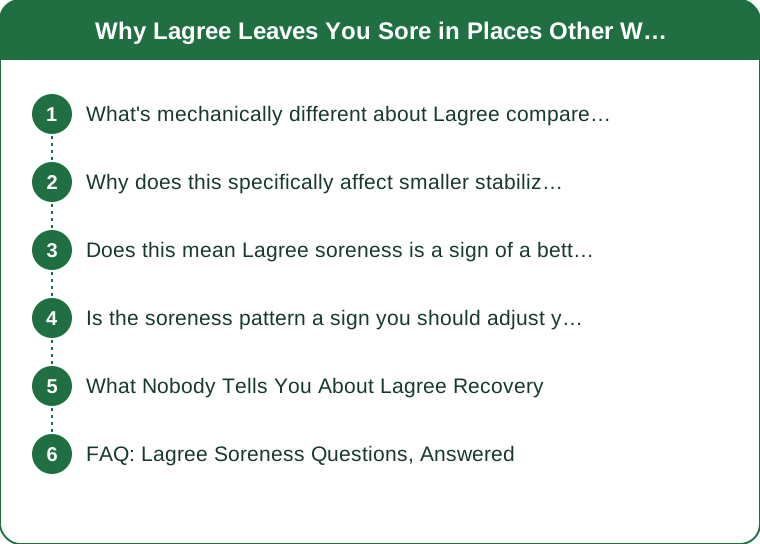
What’s mechanically different about Lagree compared to typical strength training?
Lagree’s defining feature is extended time under tension — movements performed slowly, often with no full lockout or rest position, keeping target muscles continuously engaged for the full duration of a set rather than the brief peak-tension moments typical of faster reps. Research on time-under-tension training shows this approach creates more metabolic stress and different mechanical loading than fast, momentum-assisted reps, even at a fraction of the weight — which is a real training variable, not just a stylistic choice.
Why does this specifically affect smaller stabilizing muscles more?
Slow, controlled movement without momentum removes the assistance that faster reps get from stored elastic energy and momentum transfer, forcing smaller stabilizer muscles to do more continuous work to control the movement throughout its full range. These stabilizers are frequently underworked in faster-paced strength training, where prime movers and momentum carry more of the load — which is part of why Lagree soreness often shows up in unfamiliar spots like the inner thigh stabilizers or specific core muscles rather than the major muscle groups a typical lifting session targets.
Does this mean Lagree soreness is a sign of a better workout?
Not necessarily ‘better’ — different. Soreness intensity isn’t a reliable indicator of workout quality or effectiveness across different training styles, since it depends heavily on novelty (how unfamiliar the specific muscle recruitment pattern is to your body) as much as actual training stimulus. A very sore first Lagree class reflects genuine novel muscle recruitment, but that soreness typically decreases with repeated exposure even as the workout’s actual training effect remains valuable — soreness and effectiveness aren’t the same measurement.

Is the soreness pattern a sign you should adjust your regular strength training?
It can be a useful signal that time-under-tension work is a genuinely different, complementary stimulus worth including alongside more traditional strength training rather than a replacement for it. The two approaches recruit and fatigue muscle somewhat differently, and incorporating both — Lagree’s sustained tension alongside heavier, more explosive traditional lifting — can be a genuinely well-rounded approach rather than a sign one method is superior to the other.
What Nobody Tells You About Lagree Recovery
Because Lagree’s soreness often hits smaller stabilizer muscles unfamiliar with this kind of sustained load, recovery sometimes takes a bit longer to feel ‘normal’ than soreness from more familiar movement patterns — this is a genuine novelty effect, not a sign of overtraining or damage, and it typically shortens significantly after the first several classes as those stabilizers adapt to the specific demand.
FAQ: Lagree Soreness Questions, Answered
Why am I sorer after Lagree than after lifting heavier weights?
Lagree’s extended time-under-tension and lack of momentum assistance recruits stabilizer muscles more heavily than typical faster-paced lifting, producing a different and often more intense soreness pattern.
Does Lagree soreness mean the workout is more effective than regular strength training?
Not necessarily — soreness reflects novelty of muscle recruitment as much as training effectiveness. Both training styles have genuine value, and they’re not directly comparable by soreness level alone.
Should Lagree soreness decrease over time with regular practice?
Yes, typically — as stabilizer muscles adapt to the specific demand, soreness intensity usually decreases meaningfully after the first several consistent sessions, even as the workout remains challenging.
TL;DR:
- Lagree’s slow, sustained tempo creates extended time-under-tension, a genuinely different training stimulus than fast, momentum-assisted reps
- This recruits smaller stabilizer muscles that typical strength training under-engages
- Soreness reflects novelty of recruitment more than workout superiority — it’s different, not simply ‘better’
- Combining Lagree with traditional strength training covers both training stimuli rather than replacing one with the other
The unfamiliar soreness isn’t your body reacting badly — it’s stabilizer muscles doing real work they don’t usually get asked to do.
See It in Motion
Seen here: High Waist Yoga Leggings with Side Pockets — shop it on bubblelime.com
Keep Reading
This article is for general informational and styling purposes only. Fit, sizing, and product availability may vary.