Why the Same Lagree Class Feels Harder in the Front Row
Quick Answer: In any row but the front, you pace off the people ahead of you without deciding to - matching their tempo, their range, and their moment of giving up. The front row removes that reference entirely, so you rely on the instructor’s cues and your own effort. The work is the same; the pacing support is gone, which is why it feels harder and why it is worth doing.
You booked late and got the front row, and the class you have taken forty times felt like a different class.
Nothing changed except what you could see.
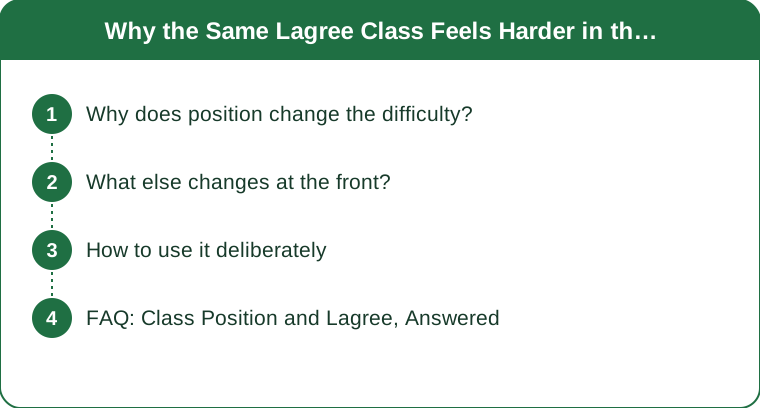
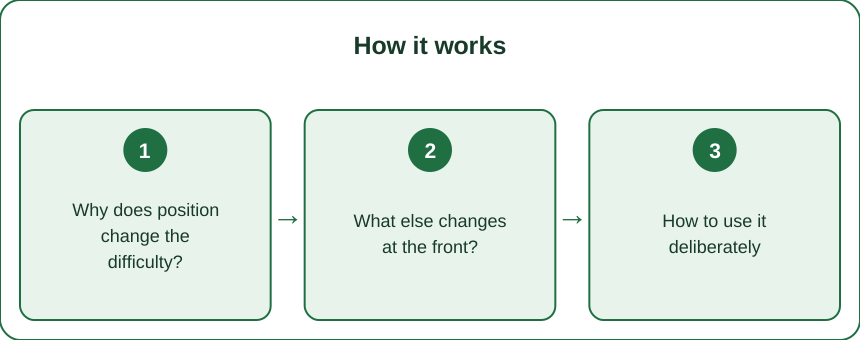
Why does position change the difficulty?
You have been pacing off other people the whole time. In rows behind the front, your peripheral vision continuously samples the tempo, range, and effort of the machines ahead, and your body matches them without any conscious decision.
That matching includes the moment people stop. When two people in front lower out of a move, the pull to follow is strong and largely invisible - which means someone else has been deciding the length of your sets.
It also includes range. If the people you can see are working at a shortened range, yours quietly shortens too, and Lagree depends heavily on full range under slow tempo.
In the front row none of that exists. You have the instructor’s voice and your own perception of effort, both of which are considerably more demanding than copying.
Mirror position compounds it. The front row usually has the clearest view of the mirror and the least ability to hide, which raises self-monitoring and, with it, perceived effort.
None of this means the front row is harder work in a physical sense. It means you are doing the work you were always meant to be doing, without the assistance you did not know you had.
What else changes at the front?
Tempo accuracy improves and that costs you. Lagree’s difficulty comes largely from slow, controlled tempo, and being close to the instructor means you actually hit it rather than drifting slightly fast to keep up with the room.
Slightly fast is significantly easier. Momentum does part of the work, and losing momentum is a genuine increase in load without any change to the springs.
You get more direct correction, which means better form, which usually means harder. A cue that fixes your hip position turns an exercise you were partially avoiding into the one it was designed to be.
The mirror gives you real feedback. Seeing your own shake and range makes it much harder to quietly shorten a movement, and it is the reason many people find the front row mentally tougher rather than physically.
Sound and cues arrive earlier, so transitions happen on time rather than half a beat late, which removes the small rests that a half-beat delay creates over a 45-minute class.
And you cannot check the clock discreetly, which for a lot of people is the single biggest difference.

How to use it deliberately
Take the front row on purpose once every few weeks, not as a punishment but as a calibration. It tells you what your actual effort level is without the room supporting it.
Go one spring lighter your first time there. Correct tempo at a lighter load is harder than fast tempo at a heavier one, and starting lighter lets you find out what full tempo actually feels like.
Pick one cue to focus on for the whole class - tempo, or range, or a specific position. The front row provides more information than you can use at once, and choosing one makes it usable.
Then go back to your usual spot and keep the tempo. The transfer is the point: once you know what correct tempo feels like, you can hold it anywhere, and that is worth more than any spring change.
Expect it to feel harder for two or three classes before it normalises. That adjustment is the same familiarity effect that made your usual row feel easy.
And if the front row makes you anxious rather than focused, the second row is nearly as useful and considerably more comfortable. The aim is honest pacing, not exposure for its own sake.
FAQ: Class Position and Lagree, Answered
Is the front row actually harder?
The work is identical. What changes is that you lose the visual pacing from the people ahead, so you rely on your own effort and the instructor’s tempo - which usually produces more work, not less.
Should I go lighter on springs in the front row?
One spring lighter your first time is sensible. Hitting correct tempo at a lighter load is harder than drifting fast at a heavier one, and tempo is where Lagree’s difficulty lives.
Why do I stop when the people in front of me stop?
Because peripheral matching is automatic. Your body samples the tempo and effort around you continuously, including when others give up, and follows without a conscious decision.
Does the mirror make it harder?
For most people, yes - it raises self-monitoring and makes it much harder to quietly shorten range. That is also exactly why it is useful.
How often should I take the front row?
Every few weeks is enough to calibrate. The value is in transferring the correct tempo back to your usual spot, not in staying at the front permanently.
What if the front row makes me anxious?
Use the second row. It gives most of the same benefit with considerably less exposure, and honest pacing is the goal rather than discomfort.
Why does it feel easier again after a few classes?
The same familiarity effect that made your usual row comfortable. Once the front row is normal, its calibration value drops - which is why occasional rotation works better than a permanent move.
TL;DR:
- In any row but the front, you pace off the people ahead - their tempo, their range, and their moment of stopping.
- The front row removes that reference, so you work from the instructor’s cues and your own effort instead.
- Correct slow tempo is significantly harder than slightly fast tempo, because momentum stops doing part of the work.
- Go one spring lighter your first time and pick a single cue to focus on for the whole class.
- Take the front row every few weeks as calibration, then transfer the correct tempo back to your usual spot.
If the front row feels more exposing than useful, the second row gives most of the same benefit.
See It in Motion
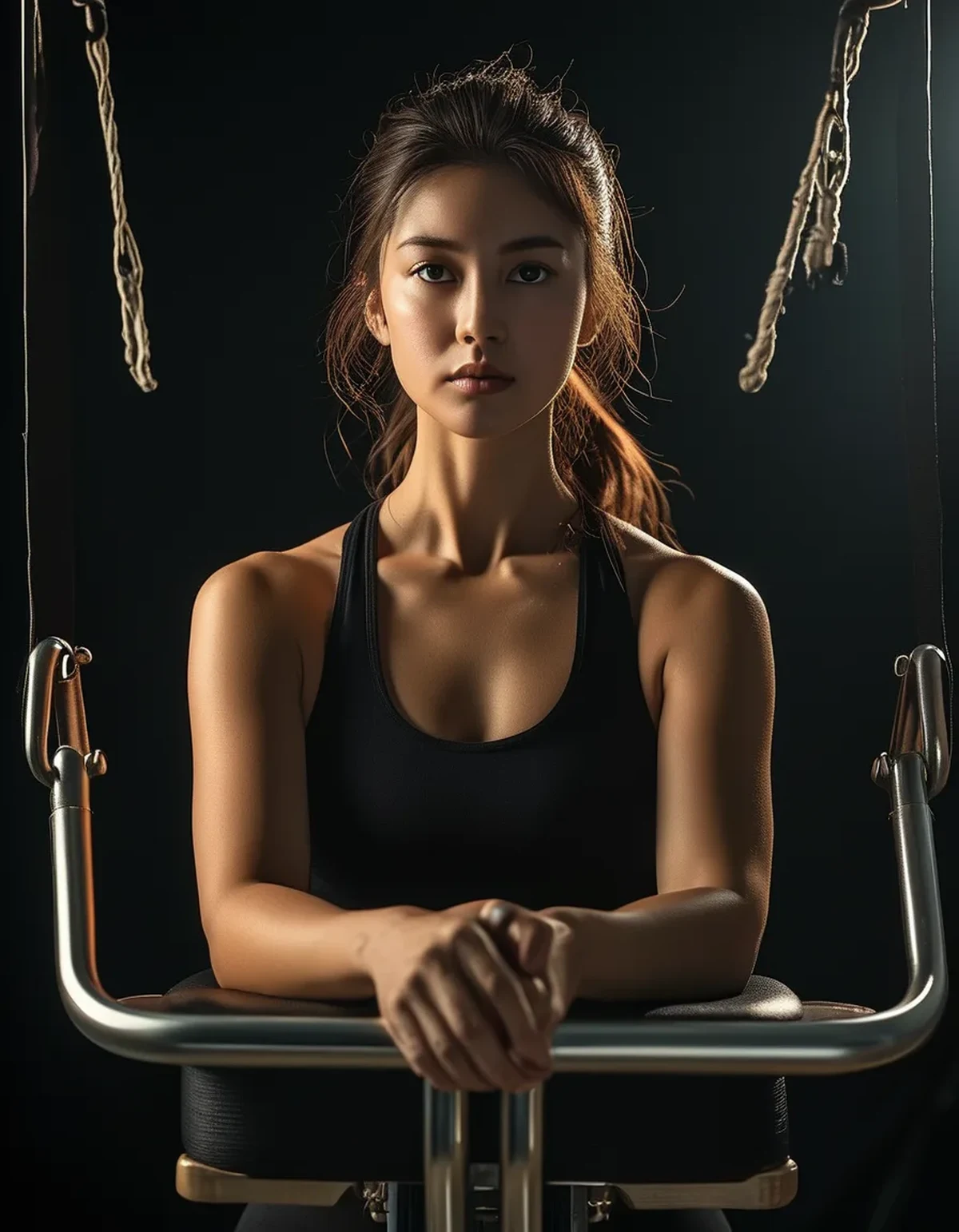
Seen here: Racerback Tank Top - White — shop similar styles on bubblelime.com
Keep Reading
This article is for general informational and styling purposes only. Fit, sizing, and product availability may vary.