Lagree vs Pilates: The Megaformer Isn't a Reformer (And Your Goals Pick the Machine)
Quick Answer: A Megaformer is longer than a Reformer, uses heavier springs, and is built for one thing: keeping muscles under constant tension with no rest. Lagree is slow-tempo strength endurance — you shake, you burn, you finish in 45 minutes. Pilates is a movement-quality system with a rehabilitation lineage — precision, alignment, breath. If you’re new or coming back from injury, start with Pilates. If you’re conditioned and want low-impact intensity, Lagree.
They look almost the same. Both are sliding carriages on springs. Both are core-first and low-impact. Both cost more per class than you’d like.
Then you take a Lagree class and spend minute four of a plank position wondering whether your legs are supposed to be doing that. They are. That’s the product.
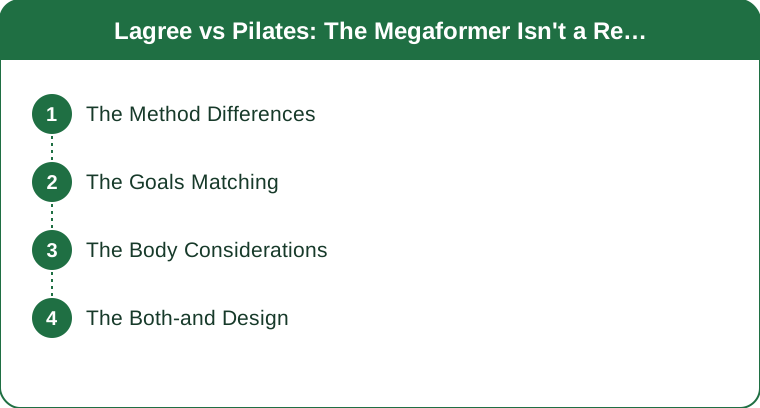
What’s the difference between a Megaformer and a Reformer?
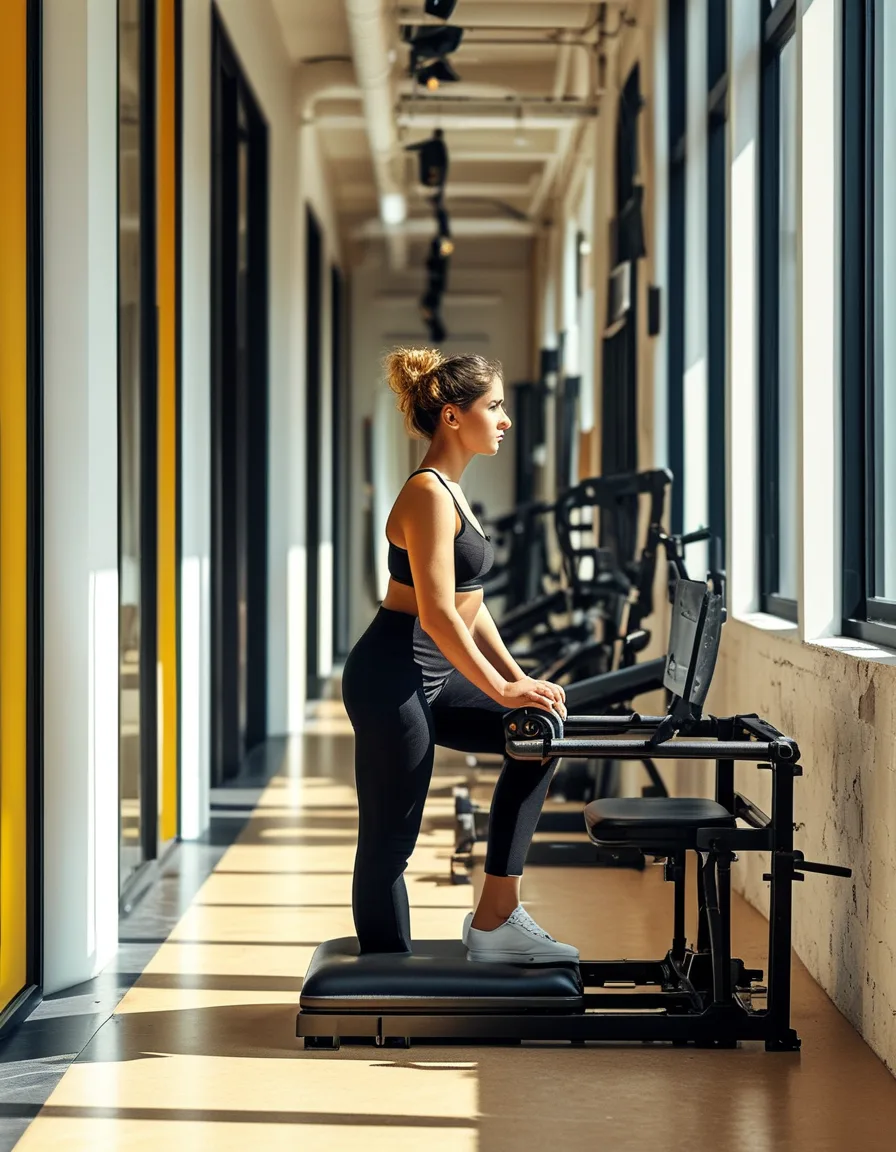
The machine itself. The Megaformer is longer, with front and back platforms, additional handles and cables, and a heavier spring range. Sebastien Lagree developed it specifically to make his method possible — the extra length allows the wide, deep positions that keep tension on continuously.
The Reformer is the classic Pilates apparatus, designed by Joseph Pilates. Lighter springs, and the springs are as much a feedback tool as a resistance tool — they tell you when you’ve lost alignment.
Tempo. This is the real dividing line. Lagree runs on a slow four-count tempo — four counts out, four counts back, no pause, no rest, for the whole exercise. Pilates uses controlled but varied pacing led by the breath, with transitions and setup time between exercises.
Intent. Lagree was engineered as strength-endurance training; the shaking muscle is the intended outcome. Pilates was built as a movement system emphasizing precision, control, alignment, and breath, with a long history in rehabilitation settings.
The room. Lagree studios tend to be dark, loud, and driving. Pilates studios tend to be brighter and cue-rich, with an instructor correcting positions. One is a workout; the other is a practice.
The shared DNA. Both are low-impact, core-first, spring-resisted, and control-focused. That family resemblance is exactly why shoppers get confused.
Which one should you pick?
You want strength and sweat, and you’re already conditioned: Lagree. It’s the closest thing to HIIT intensity you’ll get without impact or jumping.
You’re new to any of this: Pilates first. You need the alignment vocabulary — what neutral spine feels like, how to engage without gripping, how to breathe under load. Roughly six months of Pilates makes Lagree both safer and considerably more effective.
You’re rehab-adjacent or post-injury: Pilates, clearly. The physiotherapy heritage, the modification culture, and the instructor attention are all built for it. Lagree’s whole design is continuous tension to failure, which is the wrong first stop after an injury.
You’ve plateaued in Pilates: Lagree is a genuine shock stimulus. If your Reformer classes have stopped feeling hard, this is the jump.
You have 45 minutes and nothing more: Lagree. It’s engineered for density, and there’s very little standing around.
You’re pregnant or postpartum: specialized prenatal or postnatal Pilates is the established path, with instructor guidance on intra-abdominal pressure and positioning. Get clearance first, and tell the instructor before class rather than after.
You’re hypermobile: Pilates’ precision and end-range control focus tends to serve bendy bodies better. Lagree can work too, with the rule of stopping at about 80% of your available range rather than sinking into your end range.
You have sensitive knees: both are low-impact, but Lagree’s deep lunge positions ask a lot of the knee. Pilates modifies more readily.

What nobody tells you before your first Lagree class
The shaking is the point, and it’s disconcerting. Instructors will tell you to embrace it. What they mean is that time-under-tension to muscular failure produces involuntary tremor, and it’s expected. What’s not fine is when your form collapses — that’s the signal to come out of the position.
You will be bad at it for three classes. Not unfit — bad. The transitions are unfamiliar, the machine has more parts than you expect, and everyone else knows the choreography. This passes.
Grip strength is a surprise limiter. A lot of positions are held through the handles, and your hands may give out before the target muscle does.
Neither one is cardio, exactly. Your heart rate goes up in Lagree, but it’s muscular endurance, not aerobic training. Neither replaces zone-2 work.
Neither replaces strength training. Both are excellent, and neither loads your spine and hips the way a squat or a deadlift does. If bone density and maximal strength are goals, you still need a barbell or dumbbells somewhere in your week.
The price is the real filter. Both are premium-priced. Buy a class pack and trial it before committing to a membership — the method you’ll actually attend twice a week beats the one you admire on paper.
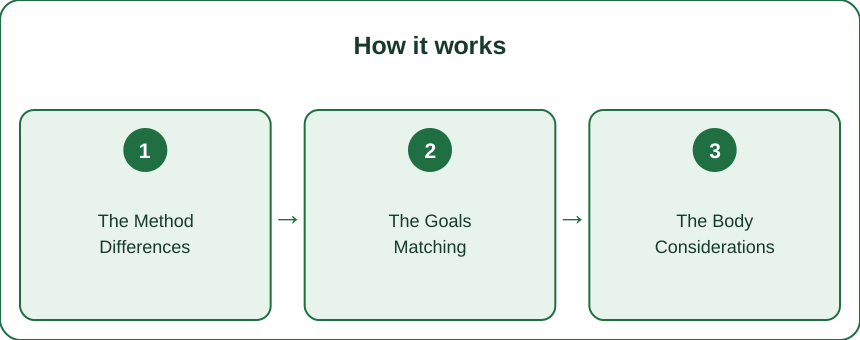
The both-and design
The two methods complement each other well, and plenty of people run both.
A workable week: one Pilates session for precision and mobility, one Lagree session for intensity, plus whatever strength or cardio you already do.
Sequence matters. Learn Pilates fundamentals before adding Lagree intensity. Building high-intensity work on top of unexamined form is how people accumulate a nagging neck or lower back. The reverse order works badly.
Flex by season. In a stressful stretch, downshift to Pilates — the breath work and slower pacing are genuinely kinder to a taxed nervous system. In an energetic stretch, lean Lagree.
Bridge with mat work at home. 20 minutes of mat Pilates between studio visits maintains the core work of both practices for free.
When to check with a professional
Get clearance from a clinician before starting either if you’re pregnant or newly postpartum, recovering from surgery or a recent injury, or managing a spinal condition, uncontrolled blood pressure, or a hernia. Tell the instructor about any of these before class, not during. Sharp pain — as distinct from muscle burn — means come out of the position and ask.
FAQ
Is Lagree harder than Pilates?
By intensity, generally yes — the slow tempo under constant tension with no rest is designed to reach muscular failure. By skill demand, Pilates asks more, because precision, alignment, and breath coordination take longer to learn than enduring a burn does. Different kinds of hard.
Can a beginner do Lagree?
Yes, but a beginner-specific or intro class is strongly advisable, and many people do better with a few months of Pilates first. Standard Lagree classes assume some baseline conditioning and move quickly through transitions, which makes it easy to hold poor positions under real load.
Is a Megaformer better than a Reformer?
Neither is better — they’re built for different jobs. The Megaformer is built for intensity and strength endurance. The Reformer is built for precision, feedback, and a broader exercise vocabulary, including rehabilitation work. Your goal picks the machine.
TL;DR:
- Megaformer ≠ Reformer: longer machine, heavier springs, engineered for continuous tension.
- Lagree = slow four-count tempo, strength endurance, 45 minutes, you shake.
- Pilates = precision, alignment, breath, rehab lineage, broader exercise vocabulary.
- Beginners and post-injury: start with Pilates. Conditioned and want low-impact intensity: Lagree.
- Plateaued in Pilates? Lagree is a real shock stimulus.
- Neither is cardio, and neither replaces loaded strength training.
- If you run both: Pilates fundamentals first, then add Lagree — not the reverse.
See It in Motion
Seen here: Super High Waist Embossed Yoga Leggings with Inner Pocket — shop it on bubblelime.com
Keep Reading
This article is for general informational and styling purposes only. Fit, sizing, and product availability may vary.