How Many Lagree Classes a Week Is Actually Productive?
Quick Answer: For most people, 3 to 4 Lagree classes a week is the productive range. Lagree is genuine resistance training performed under prolonged time under tension, which produces real muscular damage requiring 48 hours of recovery for a given muscle group. Five or six classes a week rarely produces better results than four and frequently produces worse ones, because the sessions stop being hard enough to drive adaptation. If you train elsewhere too, 2 to 3 classes is usually the right number.
The common error is treating Lagree as cardio you can repeat daily.


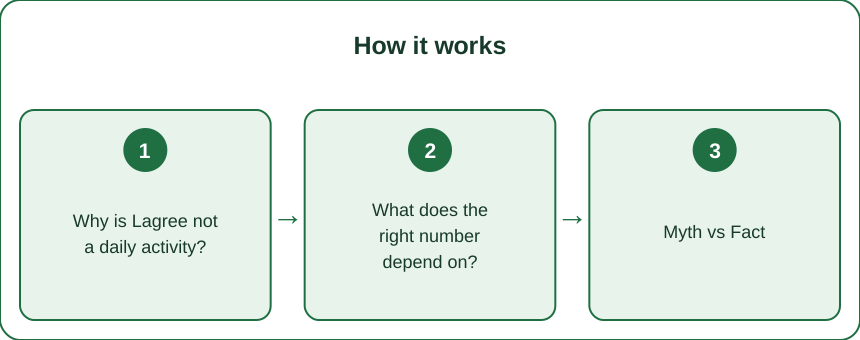
Why is Lagree not a daily activity?
Because of what it does to muscle, which is different from what a cardio class does.
Lagree is resistance training with very long time under tension - slow, controlled movements held under load for extended periods, frequently 60 seconds or more per exercise. That combination produces significant mechanical tension and metabolic stress, which are two of the primary drivers of muscular adaptation.
Adaptation happens during recovery, not during the class. Muscle protein synthesis is elevated for roughly 24 to 48 hours after a resistance session, and that window is when the improvement actually occurs.
Training the same muscles again inside that window interrupts the process. You accumulate fatigue without accumulating adaptation, which is precisely how a plateau forms while your attendance record looks excellent.
Lagree is also full-body by design. Unlike a gym split where legs recover while you train upper body, most Lagree classes work everything. There is no built-in rotation, which means frequency has to do the job that programming does elsewhere.
The tell that you have overshot: classes feel easier but you are not progressing, your shaking arrives sooner than it used to, and you feel flat rather than sore. Performance stagnation with high attendance is the signature of too much frequency, not too little effort.
What does the right number depend on?
Four variables, and honest answers to them give you your number.
Is Lagree your only training? If yes, 4 classes a week works well for most people, with three days of genuine rest or light activity. If you also lift, run, or cycle, 2 to 3 is more appropriate, because your total load includes everything.
How intensely do you take each class? A class taken at genuine effort - shaking, failing, needing the full transition time - demands more recovery than one taken at 70%. Four hard classes beat six moderate ones for almost everyone.
How is your sleep? Recovery capacity is largely a sleep story. Under 7 hours consistently, drop one class rather than pushing through - this is the single most common reason people stop progressing on a frequency that used to work.
How new are you? Beginners need more recovery, not less. Start with 2 classes a week for the first month, then 3, then assess. The soreness after the first few classes is genuinely significant and it is not a sign that you should train through it.
A reasonable default: 3 classes a week for most people, 4 if Lagree is your only training and you sleep well, 2 if you are new or training hard elsewhere.

Myth vs Fact: Lagree Frequency
Myth: More classes means faster results. Fact: Adaptation is limited by recovery, not by exposure. Beyond roughly 4 sessions a week, additional classes usually add fatigue rather than progress.
Myth: You should never be sore if you are conditioned. Fact: Mild soreness after a hard class is normal at any level. Soreness lasting more than 72 hours, or soreness that accumulates week over week, is the signal to reduce frequency.
Myth: Lagree replaces strength training entirely. Fact: It is genuine resistance training and builds real strength endurance, but it does not load the spine or the posterior chain the way heavy compound lifting does. Many people get the best results combining 2 to 3 Lagree classes with one or two lifting sessions.
Myth: Cardio is not needed if you do Lagree. Fact: Lagree elevates heart rate but is not a substitute for dedicated cardiovascular training. Two to three sessions of zone 2 work weekly complements it well and does not interfere with recovery.
Myth: Shaking means it is working. Fact: Shaking indicates neuromuscular fatigue, which is a reasonable in-class signal but a poor measure of a training programme. Progress over weeks - more time under tension, higher spring loads, better form - is the real measure.
What does a well-built week look like?
Three templates, depending on what else you do.
Lagree only, 4 classes: Monday, Tuesday, Thursday, Saturday. Two consecutive days is fine occasionally; three in a row is where quality drops. Keep Sunday genuinely restful.
Lagree plus lifting, 3 classes: Lagree Monday, Wednesday, Friday; lifting Tuesday and Saturday. Do not stack Lagree the day after heavy legs - the class will be poor and the recovery worse.
Lagree plus running, 2 to 3 classes: Lagree on the days after easy runs, never before a hard run or a long run. Legs that shook on Tuesday will not perform on Wednesday, and this is where most runners get the combination wrong.
Signs your frequency is right: you feel challenged in each class, you progress on spring load or time under tension over 6 to 8 weeks, and you arrive at each class wanting to train.
Signs to reduce: persistent fatigue, sleep disruption, classes feeling harder rather than easier over a month, elevated resting heart rate, or losing enthusiasm for a class you used to look forward to.
And as autumn arrives, two practical notes: studios get busier from September, so book earlier and expect the class you rely on to fill; and cooler rooms mean arriving with warmer layers and taking the first few minutes of a class more carefully, since the warm-up window matters more when you walked in cold.
This is general training information, not medical advice.
FAQ: Lagree Frequency Questions, Answered
Can I do Lagree every day?
You can attend, but it is unlikely to produce better results and often produces worse ones. Muscle needs roughly 48 hours to adapt, and Lagree works the whole body each session.
How many classes a week for weight loss?
Three to four, combined with adequate protein and daily movement. Frequency beyond that does not meaningfully change the outcome and increases the chance of burnout or injury.
Should I take a class if I am still sore?
Mild soreness is fine and often eases during class. Significant soreness that alters your movement means taking a rest day or choosing a lighter session.
Is Lagree enough on its own?
For general strength endurance and body composition, it can be. For maximal strength, bone density, and cardiovascular fitness, adding heavy lifting and dedicated cardio gives a more complete picture.
How long before I see results?
Most people notice strength and endurance changes at 4 to 6 weeks and visible composition changes at 8 to 12, assuming consistent attendance and appropriate nutrition.
TL;DR:
- 3 to 4 classes a week is the productive range; 2 to 3 if you also lift or run, and 2 for your first month.
- Lagree is resistance training with long time under tension - muscle needs about 48 hours to adapt, and classes are full-body so there is no built-in rotation.
- Four hard classes beat six moderate ones. Sleep under 7 hours consistently means dropping one, not pushing through.
- Reduce if you see persistent fatigue, classes feeling harder over a month, disturbed sleep, or lost enthusiasm.
The reframe that helps is treating Lagree as strength training that happens to be exhausting rather than as cardio that happens to be hard. Strength training gets programmed with rest days, and the results show up on the days you are not in the studio.
See It in Motion
Seen here: High Waist Yoga Leggings with Inner Pocket — shop it on bubblelime.com
Keep Reading
This article is for general informational and styling purposes only. Fit, sizing, and product availability may vary.